

Your restaurant menu is not a document. It is a sales strategy. And if it has not changed in the last six months, it is probably costing you more than you realise.
Restaurant owners on Reddit say it plainly in community threads: "My regulars know the menu better than my staff, and that used to feel like a compliment. Now I think it means they are bored." Another common one: "I kept my bestsellers for three years and my revenue has been flat for three years. Coincidence?" These are not edge cases. They are the pattern.
Menu fatigue is real, seasonal ingredients are a margin lever most restaurants ignore, and the gap between a pretty menu and a profitable one is smaller than you think. Here are the five reasons changing your restaurant menu items is one of the highest-ROI moves you can make this year.
Reason 1: Does Changing Your Restaurant Menu Seasonally Actually Reduce Food Costs?
Yes - and the numbers are not close. Seasonal menu planning reduces food costs by 15 to 25 percent by replacing out-of-season imports with locally available produce that is both cheaper and fresher. But the margin benefit is only half the story.
Restaurants that build a seasonal menu update strategy see a 26 percent jump in orders when they introduce limited-time seasonal items, according to menu planning research from Supy. The psychology is straightforward: if something is only available for six weeks, customers come now instead of later. Urgency is a restaurant’s oldest friend.
Seasonal menu changes for Indian restaurants are particularly powerful. Monsoon specials, winter warmers, summer coolers - each season gives you a genuine reason to update the menu, generate social media content, brief your staff on new storytelling, and pull in both new faces and existing regulars who are curious about what changed.
A static menu is a missed opportunity every single season. Seasonal menu planning is not a creative exercise. It is a revenue update strategy.
Naira Tap makes seasonal menu planning operationally painless. You update items, photos, descriptions, and pricing from one dashboard in under a minute. No printer calls. No laminated-card replacement. The menu your customer sees at the table is always the one you intended.
Reason 2: Does a Pretty or Aesthetic Restaurant Menu Actually Increase What Customers Spend?
A pretty menu is not vanity. It is a conversion tool. The research on this from the QSR world is unambiguous: digital menus with high-quality food photography and clean visual hierarchy consistently drive higher order values than text-only or low-quality visual menus.
McDonald’s reported a 30 percent increase in average order value after rolling out aesthetic digital kiosk menus, according to 2025 QSR industry data from Toast. PDQ Chicken saw a 25 percent ticket lift from the same approach. The mechanism is simple: when customers can see what they are about to order, they order more of it - and they order more expensive versions of it.
An aesthetic restaurant menu does three things a text-based menu cannot. It triggers appetite before a decision is made. It builds perceived value for your higher-priced items. And it removes the friction of imagining a dish - because the customer can already see it.
The best digital menu platforms for quick service restaurants are not just order-taking tools. They are visual merchandising tools. The menu is the store display. Treat it like one.
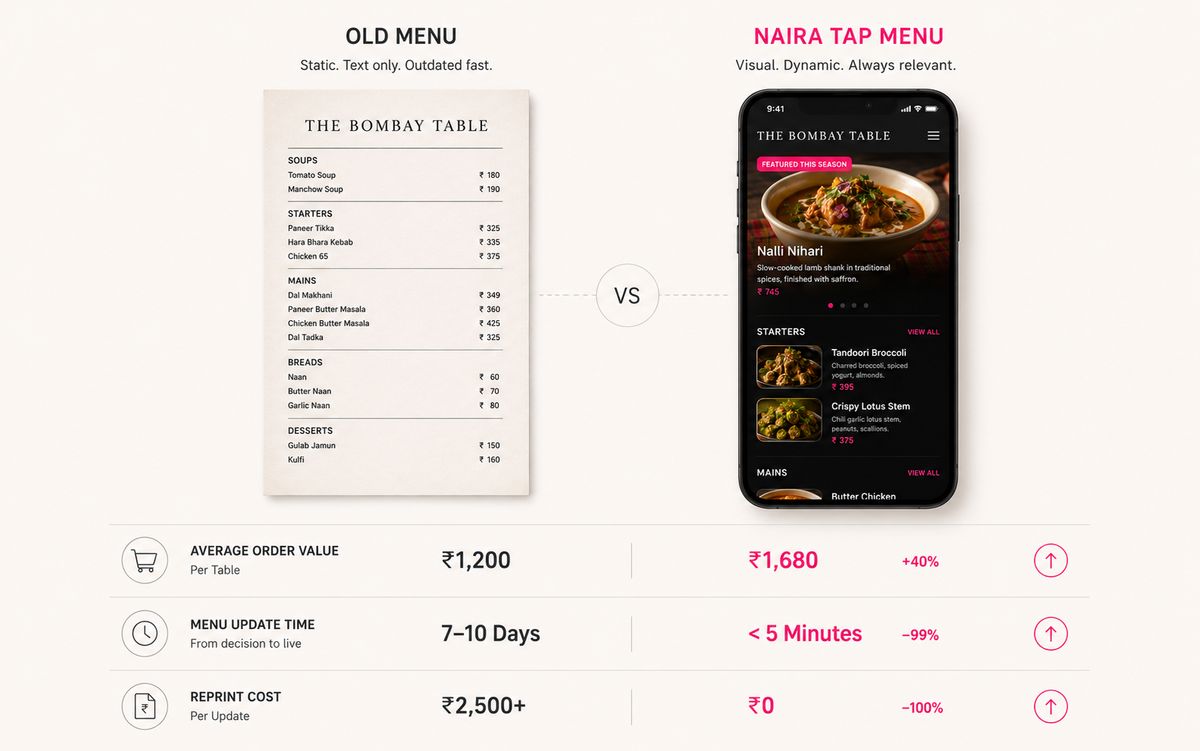
Naira Tap is built exactly for this. Every item on your menu gets a photo slot, a description field, a tag for dietary preferences, and a highlight option for your high-margin items. Your menu looks like it belongs in a food magazine - and it updates in real time whenever you change it.
Top QSR software for digital menu boards should be doing this automatically. If your current system makes updating an image feel like filing a tax return, that is a problem worth fixing.
Reason 3: Does Menu Optimisation and Engineering Actually Improve Restaurant Profit Margins?
Restaurant profit margins in India average between 3 and 5 percent according to the National Restaurant Association’s 2025 State of the Industry report. At that margin, a single underperforming item with high food cost and low order frequency can wipe out what a busy weekend earns.
Menu engineering is the discipline of classifying every item on your menu by profitability and popularity, then making deliberate decisions: promote the stars, reprice the question marks, redesign the ploughhorses, and remove the dogs entirely. According to Lightspeed’s menu engineering guide, restaurants that implement menu engineering see a 10 to 25 percent increase in profitability - without raising all prices across the board.
Restaurant menu optimisation is not a one-time exercise. It should happen every time you update your menu - which means every quarter at minimum. Each round, you ask the same question: is this item earning its slot, or is it taking up space that a better dish could occupy?
Menu engineering software does not need to be expensive or complicated. What it needs to do is tell you which items are making you money and which are quietly draining it. Everything else follows from that.
Menu pricing strategies are a core part of this. Changing a price by Rs. 20 on your three highest-volume items can move your margin more than cutting food waste by a third. Pricing is a menu update. Most restaurant owners treat it like an emergency rather than a strategy.
Naira Tap lets you run this cycle without friction. Update item prices, reorder the menu layout to push high-margin items above the fold, add or remove dishes, and see the change reflected live across every table in your restaurant.
Reason 4: Do New Menu Items Actually Bring New Customers to Your Restaurant?
72 percent of people use social media to research restaurants before visiting. And the single most shareable thing a restaurant can post is a new dish. Not a discount. Not a generic "we’re open" post. A new, visually striking item that people have not seen before.
This is why menu changes are a customer acquisition strategy, not just an operations task. When Chai & Co. launches a monsoon chai flight or Table No. 7 drops a new tasting menu for winter, the content practically creates itself. The dish is the announcement. The announcement is the marketing.
Restaurant menu fatigue is the silent killer of repeat visits. When loyal customers know your menu by heart, the only reason to come back is the food itself - and that bar gets higher every visit. A new section, a seasonal special, or even a rotated dessert gives regulars a reason to make a plan rather than a habit out of visiting.
The restaurants that consistently attract new customers are not necessarily the ones with the best food. They are the ones with the most reasons to be talked about. A new menu item is a reason.
Naira Growth lets you use your customer database to amplify every menu change. When Saffron House adds a new item, Naira Growth sends a targeted message to everyone who visited in the last 45 days. First look. Early access framing. That kind of campaign turns a menu update into a revenue event rather than a quiet operational change no one notices.
Want to understand how to build the loyalty system that makes those campaigns possible? See how
Naira Growth turns one-time visitors into regulars who actually come back when you have something new to show them.
Reason 5: What Is the Best Way to Update Your Restaurant Menu Without Reprinting Everything?
The best digital menu platforms for quick service restaurants solve a problem most restaurant owners have accepted as a fixed cost: every time you change an item, you reprint. And every time you reprint, you spend money, wait for a vendor, and run your old menu in the gap.
Digital orders now represent 42 percent of total QSR sales - up from just 15 percent in 2019. The restaurants winning in that channel are not the ones with the most items. They are the ones with the most accurate, up-to-date, visually compelling menus available the moment a customer opens their phone or taps a screen.
The average cost of reprinting a full physical menu for a 40-cover restaurant, including design, print, and lamination, runs between Rs. 8,000 and Rs. 25,000 per round. If you change your menu four times a year (which you should), that is a printing budget that disappears before a single dish earns you a rupee.
The best way to update your restaurant menu without reprinting anything is to switch to a digital menu platform where every change happens in real time, from your phone, at zero incremental cost.
Naira Tap is that platform. It is built for Indian restaurants and QSRs that want to run a dynamic, aesthetic, high-converting menu without depending on a printer, a designer, or a delay. You change the menu. The customer sees the new menu. No steps in between.
For quick service restaurants specifically, top QSR software for digital menu boards means your counter display, your table QR code, and your delivery listing all update at the same time from one place. That is not a feature. That is the standard your restaurant should be running on.
The full picture of how
Naira brings together your menu, billing, and customer loyalty into one operating system is worth seeing for your specific restaurant setup.
How Often Should a Restaurant Change Its Menu? The Answer Most Owners Get Wrong
The conventional answer is twice a year. The right answer is: whenever the data tells you to.
Most restaurant owners treat menu changes as major events - stressful, expensive, time-consuming. That framing comes from an era of physical menus where every change cost money and required a reprint cycle. Digital menus make that framing obsolete. With Naira Tap, a menu change takes three minutes. That changes what ‘how often’ can mean.
Prices should change when your food costs change. Not at year-end. When costs move, pricing should move. Items should rotate with seasons. Slow performers should exit within 60 to 90 days, not after an annual review. New dishes should be tested as limited-time offers before earning a permanent slot.
A good restaurant menu update strategy is not a schedule. It is a habit. The restaurants that treat menu changes as a live, responsive process are the ones that protect their margins every season, not just the season they planned for.
Your menu is already telling your customers something. Make sure it is telling them the right thing.
Try Naira Tap for free and see how a live, visual, instantly-updatable menu changes what your customers order - and how much.
Want weekly updates on what is actually working in restaurants across India - from menu trends to pricing moves to the digital tools other owners are adopting? Subscribe to the Naira newsletter and get it every Tuesday, straight to your inbox.