

Restaurant Customer Retention: Why Diners Actually Come Back
Your biryani is not the reason people come back. The clean fork is.
Most owners pour their soul into the menu and treat everything around it as background noise. The lighting, the smell near the entrance, the state of the washroom, the awkward wait to flag down a server and order. Diners notice all of it. They just never tell you. They simply do not return.
Why Customers Don't Come Back to a Restaurant
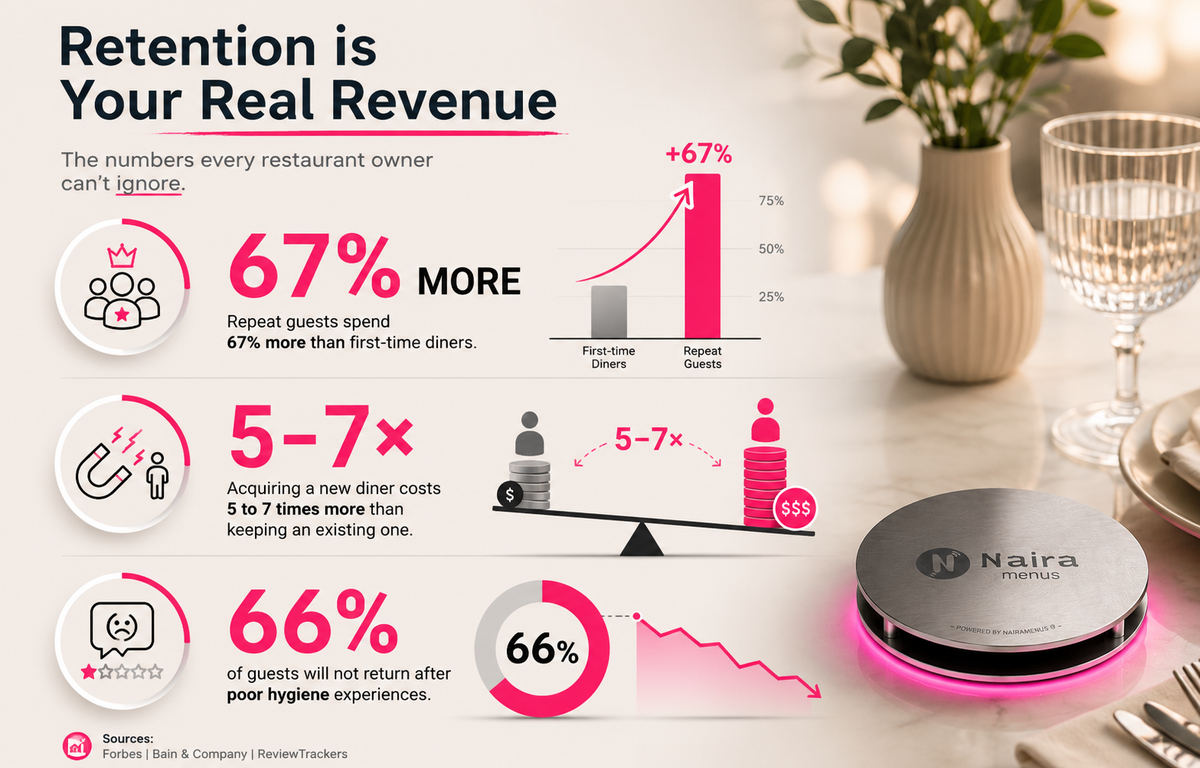
Here is the number that should keep you up at night. Across the industry, repeat guests spend 67% more per visit than first-timers, and winning a brand new diner costs five to seven times more than keeping one you already have. Yet most restaurants spend almost everything chasing new faces and almost nothing keeping the ones who already walked in.
Walk through the real reasons people quietly drop off. A sticky table they had to wipe themselves. A washroom that made them rethink the kitchen. A ten-minute wait just to place an order on a busy Saturday. None of these show up in your sales report. They show up as an empty chair next month.
Restaurant customer retention is not won at the stove. It is won in the hundred small moments around the meal.
If you have ever wondered why customers don't come back to a restaurant that serves genuinely good food, this is the gap. The food was never the problem. The experience around it was.
How Does Food Safety Management for a Restaurant Affect Customer Loyalty
Cleanliness is the most underrated retention tool you own. 66% of people will not return to a restaurant with poor hygiene, and most of them will never tell you why. They just label you in their head and move on to the next place.
Diners read your whole operation through small signals. A spotless table says the kitchen is spotless too. A clean washroom says the people handling their food care. They cannot see your cold storage, so they judge what they can see and assume the rest matches.
People trust their eyes, not your FSSAI certificate on the wall.
Strong food safety management for a restaurant runs deeper than the dining floor. It covers how you handle, label, and store everything before it ever reaches a plate. To ensure the proper protection of foods during storage, the basics still win: correct temperatures, sealed and dated containers, raw and cooked kept apart, and clear first-in-first-out rotation. None of this is glamorous. All of it is what keeps a loyal customer loyal instead of food-poisoned.
Restaurant cleanliness and customer experience are the same conversation. One is what you do. The other is what the diner feels because you did it.
How Restaurant Ambience Influences Repeat Customers
Once the place is clean, ambience does the quiet work of making people want to stay. Lighting, sound, seating comfort, even the smell that greets someone at the door. These set the mood before the first dish lands.
Restaurant ambience importance is simple to feel and easy to underrate. Harsh white light makes food look flat and people eat faster and leave. Music too loud kills conversation, and conversation is half the reason groups choose to dine out. Cramped seating turns a celebration into a chore.
Ambience is not decoration. It is the difference between a meal and a memory.
Get this right and you do more than improve dining experience for one night. You give people a reason to pick you again when they could pick anyone. A space that feels good is a space people return to without thinking about why.
Why the Ordering Experience Decides If Customers Return
Here is the uncomfortable part most owners skip. A clean, beautiful restaurant can still lose a guest at the exact moment they try to order.
Think about the friction. The menu is sticky or torn. The server is buried in the Saturday rush and cannot reach the table. The guest waves, waits, waves again. By the time the order is in, the warm glow of your perfect ambience has already cooled. The most emotional moment of the entire visit, the moment of deciding what to eat and spend, is often the clumsiest one you offer.
You can nail the lighting and the food and still lose the guest in the ninety seconds it takes them to order.
This is the retention lever almost nobody talks about. Cleanliness and ambience get a diner to relax. The ordering experience decides whether the visit felt premium or frustrating. And the feeling at the moment of ordering is the feeling they carry home.
How Tap to Order Creates a Better Dining Experience
Imagine the same table, redesigned around the guest. They sit down, tap their phone on a small coaster, and the full menu opens instantly. No torn card, no hunting for a server, no waiting through the rush. Photos of every dish, clear descriptions, and the option to order the moment they are ready.
That is what a tap to order restaurant experience feels like. The diner stays in control, the visit feels effortless, and the table turns into something they remember for the right reasons. The moment of ordering stops being the weak point of the visit and becomes a small, premium pleasure.
When ordering feels effortless, the whole visit feels considered, and considered visits are the ones people repeat.
For the owner, the Saturday night rush becomes manageable again. Guests order when ready instead of waiting on an overstretched server. The experience holds its shape even when the floor is full. That consistency is exactly what turns a one-time diner into a regular.
Restaurant Upselling Ideas That Increase Average Order Value
A smart menu does not just take orders. It quietly sells. Dishes shown with photos sell up to 30% more than text-only items, because people order what they can picture. A digital menu makes the same nudge to every single table, with no awkward pitch and no extra staff training.
That is the real shift. The best restaurant upselling ideas no longer depend on a server remembering to push the dessert. The menu does it for you, gently, every time.
The smartest upsell is the one the guest never feels as a sell.
A few upselling examples for a restaurant that work because they help the guest rather than pressure them:
- Pairing prompts. Suggest the exact side or drink that goes with a main, right when they add it.
- Visual add-ons at checkout. One tap to add a dessert or a starter just before they confirm, the highest-converting moment to ask.
- Featured high-margin dishes. Smart menu design places your best-margin items where eyes land first, not buried on page three.
- Combo nudges. Show the value of a set over individual items so the bigger order feels like the smarter choice.
These upselling techniques in a restaurant do two jobs at once. They lift the average order value and they make the meal feel more complete, which is its own quiet driver of restaurant customer loyalty. A guest who left satisfied and well-fed is a guest who comes back.
Bringing It Together
Retention is not one big move. It is a clean table, a comfortable room, and an ordering moment that feels effortless instead of awkward. Get those three right and the food finally gets the audience it deserves, again and again.
If you want the ordering moment to work as hard as your kitchen does, that is exactly the gap Naira Tap closes. It turns the most overlooked part of the visit into the part guests quietly love. Curious what that looks like on your tables? Let's talk.