

Every business owner has heard the pitch: optimize your online presence, and the customers will come. Half of them have paid for it. Most of them are still wondering whether it actually did anything.
Does online presence optimization actually work for any business?
Strip away the jargon, and “online presence optimization” means one thing: making sure the right person finds accurate, trustworthy information about you at the exact moment they're deciding whether to choose you. No magic. No algorithm worship.
And that moment happens far more often than most owners realize. 76% of consumers look at a business's online presence before they ever physically walk in - a salon, a clinic, a hardware store, a gym, anyone competing for someone's attention and money within a five KM radius.
If your business isn't showing up correctly in that moment, you're not losing to a better competitor. You're losing to Google's confusion about whether you're even open.
This applies whether you sell root canals or rotis. The mechanism is identical: be findable, be accurate, and be trusted, in that order.
Why do so many owners think online presence optimization is a scam?
Because, often, it's sold like one. Someone signs a retainer, gets a monthly PDF full of green arrows, and six months later still can't tell whether a single new customer walked in because of it. The most common reason these engagements feel like a waste is that “results” were never defined or measured in the first place - no link drawn between the activity and the register.
There's a second reason, quieter but more common: impatience. Most owners expect a switch to flip. Presence work behaves more like compounding interest than a coupon code - three to six months before movement and six to twelve before it's undeniable. Anyone promising next-week miracles is selling a feeling, not a result.
So the skepticism is fair. It's just aimed at the wrong target. The real question was never “Does this work” - it was “did anyone ever check.”
What actually changes when a business gets this right
Four things move, in this order:
- You start showing up where the decision is being made. Not your website traffic or follower count - the specific local search, map result, or “near me” query that happens thirty seconds before someone chooses.
- Your information stops contradicting itself. Same hours, same address, same number, everywhere a person might check. Inconsistency reads as “this place might not exist anymore,” and people don't take that risk.
- Your reputation becomes visible at the moment of doubt. Consumers read an average of ten reviews before they'll trust a business - so the question isn't whether you have reviews, it's whether the tenth one still makes them trust you.
- You start responding, not just existing. A business that replies to feedback signals it's alive, attentive, and accountable. Most don't bother - which means the few who do stand out by default.
None of this needs a redesign, a rebrand, or a bigger budget. It needs accuracy and attention, applied consistently.
Why restaurants are the sharpest proof of all this
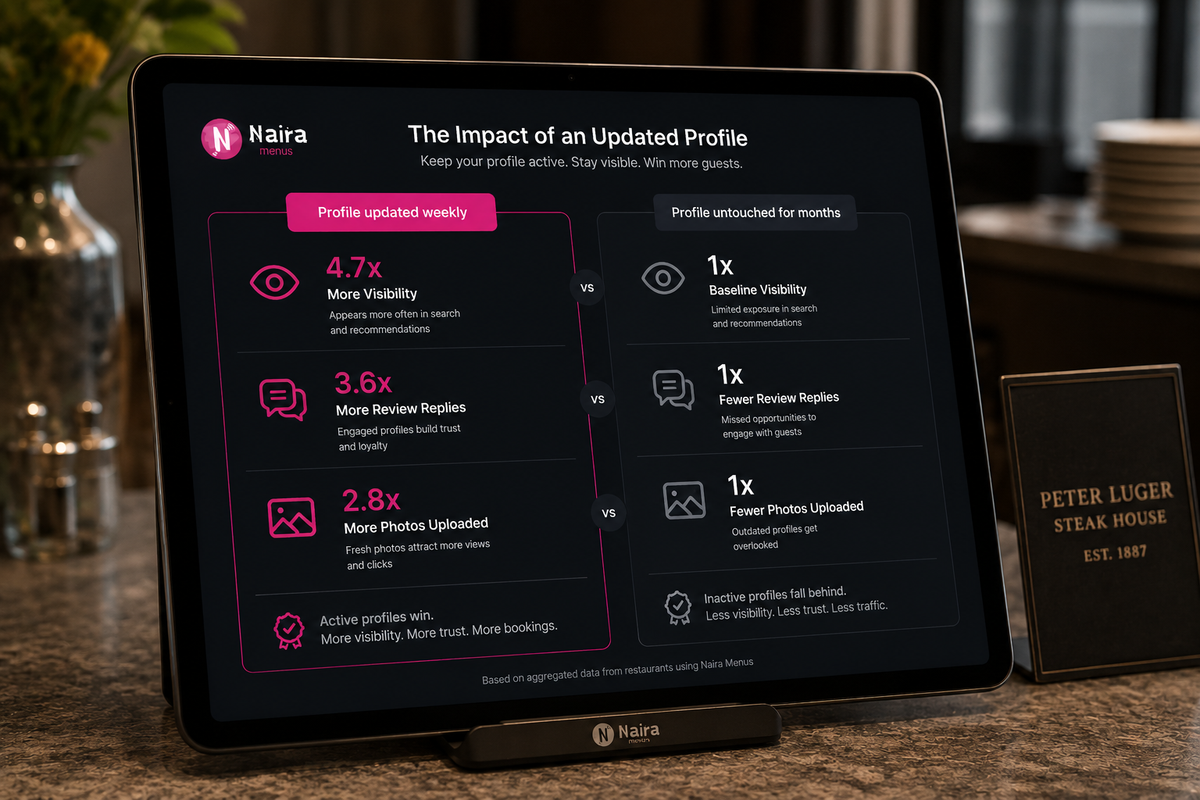
If you want to see this play out at full speed, watch a hungry person open their phone.
62% of people discover restaurants through Google before any other platform, and the decision that follows happens in under a minute: scroll, glance at the photos, skim two or three reviews, pick one, move on. No industry closes the gap between “found” and “forgotten” faster.
A restaurant with great food and a confusing online presence loses to a mediocre restaurant with an accurate one. Every single time, before either plate has been served.
This is also why restaurants make the best argument for the “every business” case above. The stakes are immediate, the competition is hyper-local, and the decision window is brutally short. If presence optimization works anywhere, it has to work here first - there's no slower-moving market to hide in.
The thirty-second decision nobody talks about
Picture it: 9:14 pm, someone standing outside three restaurants on the same street, all serving roughly the same cuisine, all within a two-minute walk of each other. They open Google. One has updated photos, a handful of recent replies to reviews, and hours that match what's posted on the door. One hasn't been touched since a rebrand two years ago - wrong number, old menu, no replies. One doesn't show up at all.
They don't debate. They don't compare menus line by line. They walk toward the one that looked like someone was paying attention. That's the whole contest, decided before a single dish was tasted.
Is being everywhere online the same as being optimized?
No - and this is where most businesses waste their effort. Posting constantly across five platforms isn't optimization. It's noise with a content calendar attached.
Being correct and current on the two or three platforms where your customer is actually deciding beats being scattered and stale across fifteen.
A restaurant that keeps its Google profile accurate, replies to reviews within a day, and posts real photos of real food will out-convert one posting daily reels to an audience that was never going to walk in tonight. Visibility without accuracy is just a louder way of being ignored.
So does it actually work?
Yes - just not in the way it's usually pitched. It doesn't work like an ad campaign you switch on and watch convert overnight. It works like a first impression that's available to make, on your behalf, to thousands of people a month, whether or not you're in the room.
The question was never whether online presence optimization works. It clearly does - the data and the queue outside the better-reviewed restaurant both say so. The real question is whether your business is the one showing up correctly when someone is thirty seconds from deciding or the one that loses before it even knew it was in the running.
That's the gap Naira closes for restaurants - keeping your presence accurate, your reputation visible, and your kitchen focused on the one thing it should actually be doing: cooking.