

QR Codes Are Everywhere. That's Exactly the Problem. Here's What Makes Customers Say “Wow” Instead.
Your customer just sat down. They pick up their phone, squint at a smudged sticker on the table, wait for a sluggish PDF to load, and pinch-zoom their way through your menu. Welcome to fine dining in 2026.
Somewhere along the way, the restaurant industry confused “digital” with “good.” QR menus killed paper and then quietly started killing the experience, too. There is a better way, and the restaurants already using it are the ones your customers are talking about.
The QR Menu Was a Pandemic Fix. Why Is It Still on Your Table?
QR codes entered restaurants as a contactless workaround. They were supposed to be temporary. Five years later, they are still here, still ugly, and still annoying your customers.
According to Restaurant Business Online, 66% of diners dislike pulling out their phone the moment they sit down, and 55% say QR menus are genuinely hard to read and navigate. Half of all customers say QR codes lessen the dining experience. That is not a small design flaw. That is your first impression, every single service, quietly underwhelming the people you want to come back.
What Your Customers Are Actually Saying (And Yes, It's Bad)
Scroll through any restaurant review thread on Reddit, Quora, or Google, and a pattern shows up fast. Customers are not quietly putting up with QR menus. They are venting.
“I came here to eat, not to troubleshoot your website on 2-bar WiFi.” That is a real complaint, written more times than anyone would want to count. Here is what people are consistently saying:
- The QR code links to a PDF that takes forever to load on restaurant WiFi.
- The menu is a portrait document opened on a portrait phone, forcing endless scrolling and pinch zooming.
- Older customers stare at the table helplessly, waiting for a staff member to walk them through it.
- Some QR links are dead. Some redirect to a site that does not load. Some ask for cookie consent before showing the biryani.
The backlash has been loud enough that several restaurant chains have already reintroduced paper menus purely because customers kept complaining. But going back to paper is not the answer either. It is just surrender dressed up as a comeback.
NFC, Explained Like You Are Not a Tech Person
NFC stands for Near Field Communication. If you have ever tapped your phone to pay at a POS, you have already used it. The same chip that handles your UPI tap is sitting inside a tiny, elegant card on your customer's table and pulling up your menu in under a second.
No camera. No scanning. No app download. No QR hunt. The customer just taps their phone against a small, premium-looking card, and the menu opens instantly in their browser. Roughly 94% of smartphones on the planet already have NFC built in. Your customers are not missing any hardware. They are just missing a reason to experience this.
The single most important sentence in this whole blog: the tap is the brand moment.
NFC vs QR: The Comparison Nobody in the Industry Wants to Print
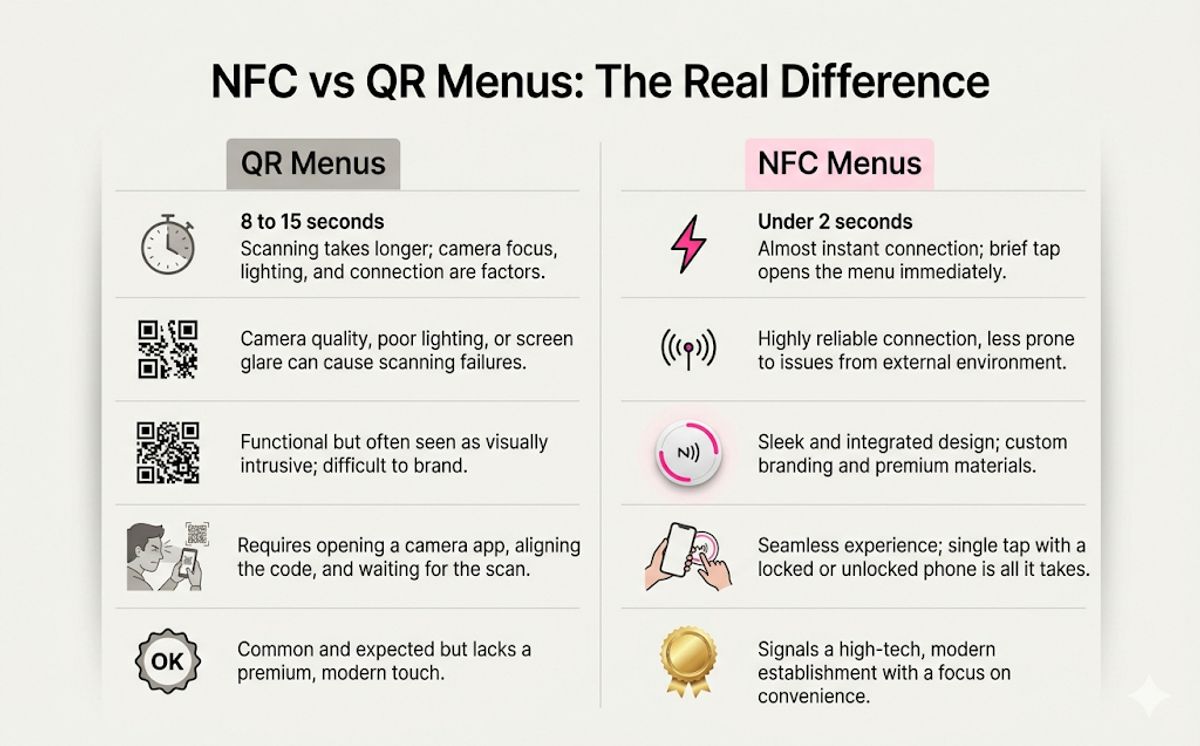
Both are “digital.” Both get rid of paper. But the actual experience is not remotely the same. Look at what happens in the first thirty seconds after a customer sits down:
Speed
QR: open camera, align, wait for link, wait for page load. Average 8 to 15 seconds on patchy WiFi. NFC: tap, menu open. Under 2 seconds, every time.
Reliability
QR fails when the code is scratched, the lighting is low, or the phone camera has auto-focus issues. NFC works through a light touch, in any lighting, even through a phone case.
Aesthetics
QR codes are printed as black-and-white squares. They are impossible to make beautiful. NFC cards can be designed, branded, and finished in premium materials that actually add to your table styling instead of cluttering it.
Customer Effort
QR asks the customer to do something. NFC asks for almost nothing. The bar for effort in a good dining experience should be zero.
The First Impression
A QR code says, “We are getting by.” An NFC card says, “We thought about this.”
Your Menu Is the Most Touched Object on the Table. Treat It Like It.
Restaurant owners obsess over crockery, lighting, playlists, and plating. Then they drop a laminated QR sticker on a beautiful wooden table and call it a day. The menu is touched more than the glasses, the cutlery, and sometimes the food itself. It deserves better.
NairaMenus NFC cards are designed to sit on a table, as they belong there. Clean finishes, minimal forms, and subtle branding that can match a third-wave specialty cafe or a fine dining restaurant. Instead of subtracting from your aesthetic, the menu starts contributing to it.
This is the quiet upgrade nobody notices directly, but everybody feels. The same reason a good restaurant uses warm lighting instead of tube lights. You do not consciously think about it, you just feel like the place has taste.
Seasonal Menu? New Dish? Price Change? Done in 90 Seconds.
Here is the part that actually saves you money. With paper menus, every price revision meant a reprint, a design brief, and a week of waiting. With QR menus, you either update a PDF and re-upload it, or you are stuck with whatever your ordering platform allows. Both are slow. Both are a hassle.
NairaMenus gives you a dashboard. Add a new dish, change a price, pull a sold-out item, and push a limited-time offer. It reflects on every single customer's phone instantly, because the NFC card just points to your live menu. No reprinting. No redesigning. No downtime.
This is not a small operational perk. It is the difference between running your menu like a product and running it like a laminated sheet from 2014.
Unpopular Opinion: Digital Does Not Mean Good
The restaurant industry has spent five years congratulating itself for “going digital.” Most of what happened was paper being replaced with a worse PDF. That is not progress. That is a copy-paste with extra steps.
A digital menu is only as good as the experience it creates. If your customer needs a tutorial to order a coffee, your technology is not making things easier; it is making things look modern while functioning worse. The point of technology in hospitality was never to impress investors. It was to make the customer's life quieter. NFC does that. QR mostly does not.
The Moment a Customer Taps the Card for the First Time
Picture this. A couple walks into your cafe. They sit down, still mid-conversation. They notice a small, minimal card at the edge of the table. Curiosity kicks in. One of them taps their phone against it, just to see what happens.
The phone lights up. A beautifully designed menu appears, styled in your brand, with the hot pink Naira accents flowing cleanly across the screen. No scrolling through a PDF. No waiting for WiFi. No, asking the server for help.
They look up, half-laughing. “That is actually really cool.” That sentence, repeated across hundreds of tables, is what builds a reputation. It is what gets screenshotted and posted. It is what makes your cafe the one people send to their friends on Instagram. That is the wow factor, and it is not an accident. It is a design decision.
The Indian Restaurant Industry Is Not Small. Neither Is the Opportunity.
According to Restroworks, India's restaurant industry is valued at $85.19 billion in 2025 and is projected to cross $139.8 billion by 2030. Restaurants that implemented digital menus reported 10 to 20% higher average check values. That is not a small bump. That is a different P&L.
The restaurants that will take the biggest slice of that growth are the ones that make the dining experience feel premium without feeling fussy. NFC menus are one of the shortest, cleanest bridges to that outcome. The upgrade is not about tech for the sake of tech. It is about building a restaurant that feels intentional in every detail a customer touches.
If Your Menu Is Still a QR Code, Your Competitors Have Already Noticed
The cafes, bistros, and restaurants investing in experience are not waiting. They are already moving their menus onto NairaMenus NFC cards because the setup is faster than a staff training session, and the payoff shows up in the first week.
Your menu is the first object your customer holds in your restaurant. The question is simple: do you want that object to feel cheap, or do you want it to feel like something worth remembering?
Book a 15-minute demo with us. See what an NFC menu looks like on your table before your competitor puts one on theirs.