

Restaurant Discovery: The Diners You're Losing to Search
Right now, someone two streets from your restaurant is hungry, holding their phone, and deciding where to eat. They will pick a place in the next ninety seconds.
If your restaurant doesn't show up in that search, you didn't lose that customer. You were never in the running.
Most owners think they compete on food, price, and vibe. In reality, you compete first on whether a hungry stranger can find you at all. Everything else happens after the search.
This is restaurant discovery through online search, and it now decides who eats where long before anyone tastes your food.
How customers find restaurants online in 2026
They search. Before they walk in, before they call, before they trust your food, they type a few words and let the results decide for them.
Today, 93% of diners check Google before choosing where to eat, and 76% of “near me” mobile searches turn into a visit within 24 hours. That is not browsing. Strong restaurant near me search visibility puts a customer with a fork in hand right at your door.
To get your restaurant found on Google at that exact moment, your listing has to be complete, accurate, and active. A blank profile simply does not appear, no matter how good the food is.
Search is also splitting into new channels. Around 22% of consumers have already used an AI tool like ChatGPT or Gemini to pick a restaurant. The question “where should I eat tonight” now gets answered by a machine that reads your online presence, not your menu board. To show up in ChatGPT restaurant recommendations, that machine has to find clean, consistent information about you first.
Your food only matters once the search puts you on the list. Discovery comes first. Everything you are proud of comes second.
Why can't customers find your restaurant online?
Walk through any restaurant owners' forum, and you hear the same two frustrations in the same tired voice.
“My Google listing barely shows up. People say they couldn't find us, and we are right here on the main road.”
“We get orders, but Zomato and Swiggy own the customer. The day we step back, the orders stop.”
Both problems share one root. The restaurant never built its own path to be discovered, so it rents one. You rent visibility from delivery apps, and you pay rent on every single order, often 25% to 40% of the bill.
To reduce dependence on Zomato and Swiggy commissions, you need a discovery channel that the apps cannot switch off. That channel is restaurant local SEO India owners fully control: your own Google presence, your own reviews, and your own visibility.
It gets worse in AI search. A recent industry report found that 83% of restaurants are completely invisible when AI tools recommend places to eat. If a customer asks ChatGPT for a good dinner spot nearby, most restaurants are not even in the conversation.
What are restaurants leaving on the table by ignoring organic search?
A lot. And the painful part is that most of it is free traffic going to the restaurant next door.
Restaurants that land in Google's top three local results get 126% more traffic and 93% more actions, like calls and direction taps, than the places ranked four to ten. Same street, same food category, wildly different footfall. The top three simply get found, and the rest get scrolled past.
Reviews decide a lot of that. The restaurant reviews’ impact on footfall is direct: restaurants in the top three Maps results average 47 more reviews than those ranked below, and a single point of rating, from 3.8 to 4.6, can lift revenue by 5% to 9% in competitive markets. Treat your reviews as a live restaurant feedback system, not a vanity score, and they tell you exactly what diners want more of.
Owners spend hours hunting for ways to improve restaurant sales: fresh combos, new offers, louder ads. Yet the cheapest lever sits untouched. If you want to know how to boost restaurant sales without spending more, start by getting found by the people already looking for you. That single shift is often how to increase restaurant sales faster than any discount.
Every diner who searches, doesn't find you, and books elsewhere is revenue you never see and never count. It does not show up as a loss on any report. It just never arrives.
Why renting customers from delivery apps costs more than organic search
Here is the belief almost every owner holds: delivery apps bring customers, so paying the commission is just the cost of doing business.
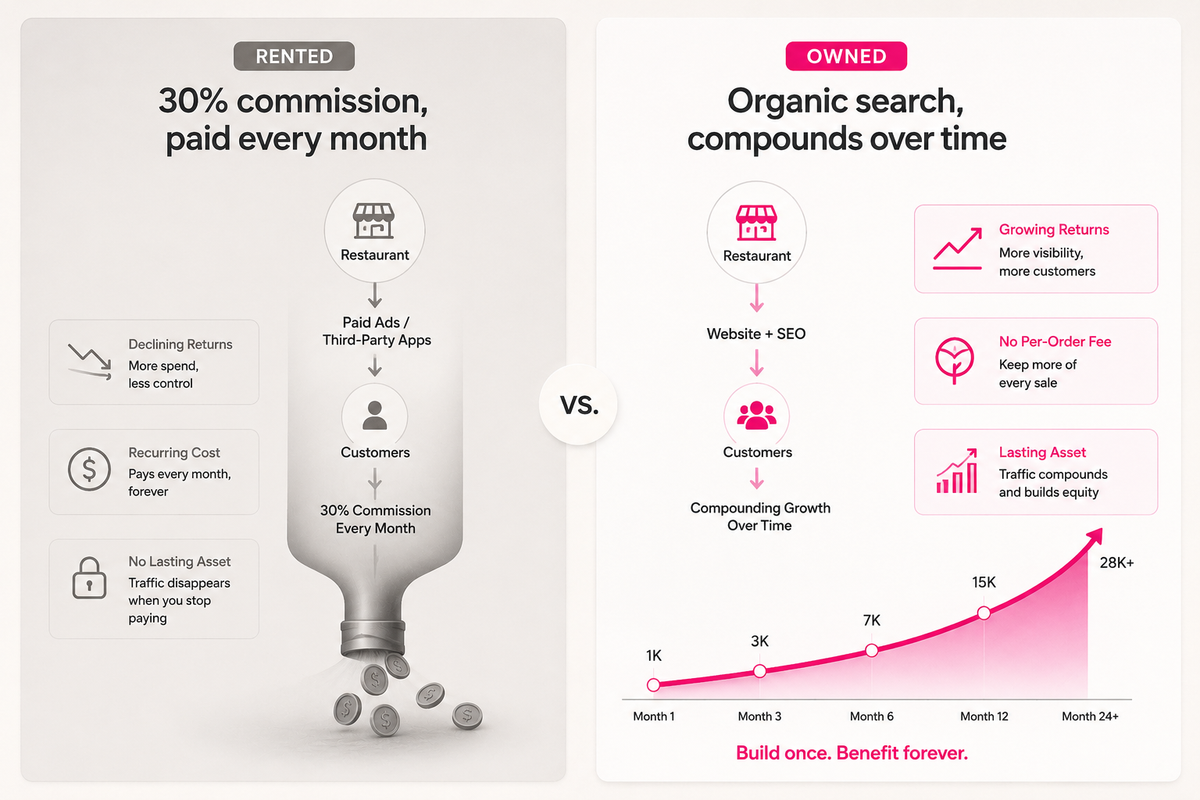
That belief is quietly draining you. A customer you get from a 30% commission order is a customer you rent. A customer who finds you through organic search is a customer you own.
The same trap sits inside Google restaurant advertising. Paid ads can put you on top in minutes, but you pay for every click, and the moment you stop paying, you vanish. Compare the organic vs. paid restaurant marketing cost over a full year, and the rented option usually wins on the invoice while losing on the math.
Run the math on one busy outlet. Say you do 1,500 delivery orders a month at an average bill of 400 rupees, with a 30% commission. That is 180,000 rupees a month, every month, just to be found, around 21.6 lakh a year. You pay it again next month and the month after, forever.
Organic discovery works the other way. The work you put into your Google profile, your reviews, and your online presence keeps paying off after you stop touching it. You build it once, and it compounds. Renting drains. Ownership grows. That gap widens every single month.
The expensive customer is not the one who costs more today. It is the one you have to keep buying tomorrow.
How can a restaurant get discovered through organic search at a lower cost?
You stop renting and start building. The good news is that organic restaurant marketing rewards effort more than budget, so a small cafe can outrank a chain that simply never bothered.
If you have ever wondered how to rank restaurant on Google Maps, a few moves do most of the work:
- Start with restaurant Google Business Profile optimization. Claim the listing, then add hours, photos, menu, and the right category. An empty profile cannot rank.
- Make reviews a habit, not an afterthought. Ask happy diners at the table. The words they use to describe your food become the keywords that get you found.
- Feed the AI engines clean information. Consistent name, address, dishes, and descriptions across the web help ChatGPT and Google actually recommend you.
- Keep showing up. Fresh photos, new posts, and recent reviews tell the algorithm you are alive and worth surfacing.
None of this is hard. It is just constant, and most owners are already running a kitchen at full tilt. That is exactly the gap that gets ignored until a competitor eats your lunch.
This is the gap Naira Growth was built to close.
Naira Growth gives your restaurant a real competitive edge in online discovery. Instead of leaving your visibility to chance or renting it from delivery apps, you get found by the diners already searching for a place like yours, on Google and in AI search, without paying a commission on every plate.
The quiet wins you never see
Picture a Saturday evening. A couple of a few minutes away opens their phone and types “best place for dinner near me.” Your restaurant appears in the top three, with bright photos and a wall of recent five-star reviews. They tap directions without a second thought.
They will never know they almost picked somewhere else. You will never know how close you came to missing them. That is the strange thing about winning discovery: the win is invisible, but the empty tables you avoid are very real.
If you are ready to stop being invisible and start getting found, take a look at Naira Growth. Come see how it works, and let's talk about getting your restaurant in front of the diners already searching for you.