

Menu Design Tricks That Increase Average Order Value in Restaurants
Most restaurants are not losing money on food cost. They are losing it on every line of the menu where nothing was suggested next to it.
You negotiate paneer down by eight rupees a kilo. You argue with suppliers on gas cylinder rates. Meanwhile a table of four walks in, orders three mains and one Coke, and walks out. Your kitchen used the same chef-hour it would have used to serve six items.
Your food cost is fine. Your average order value is the leak.
The pain every restaurant owner knows but nobody talks about
You already know what this feels like. The check lands. Four people. Two mains, one sharing plate, two lime sodas. The kitchen worked as hard as it would for a 3,000 rupee ticket. This one is 1,180.
Restaurant owner forums are full of the same frustration. “Customers order only the bestseller, skip starters, no dessert, split one mocktail between two people.” “My staff is scared to suggest add-ons because they feel pushy.” “My menu has twenty items and four of them do all the work.”
The hard truth: your problem is almost never the food. The food is the reason they came in. The problem is that between the moment they sit down and the moment they order, nobody, not your server, not your menu, not your tech, made any real attempt to help them order better.
How does menu design increase average order value in a restaurant?
Menu design is not decoration. It is the single most underused sales tool inside a restaurant.
When the menu is engineered well, three things happen on the same bill. The customer notices a higher-margin dish they would have missed. They add one pairing they did not plan to. And they do all of this feeling like it was their idea.
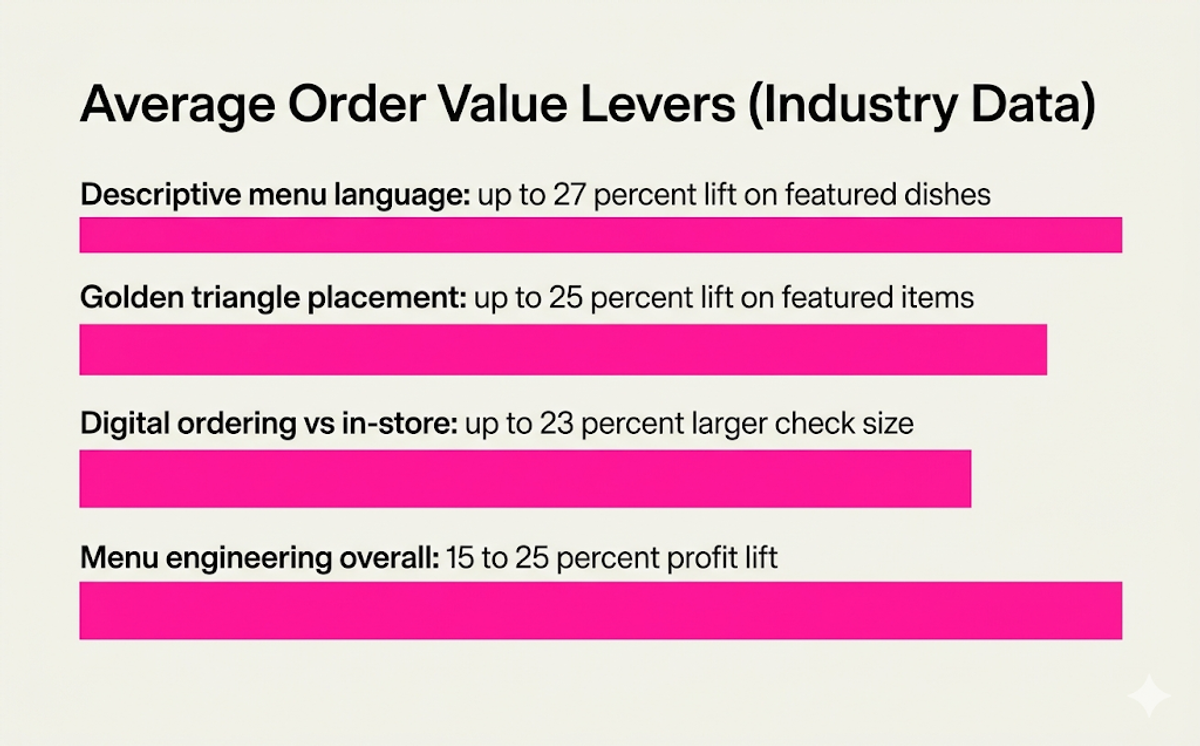
According to a Restaurant365 analysis of menu engineering research, restaurants that apply menu engineering principles see an average 15 to 25 percent increase in gross profit margins. Same kitchen, same staff, same rent. Only the menu changed.
The number that keeps showing up across studies is not bigger guest counts. It is bigger per-guest tickets, from the exact same footfall.
Where should high margin items be placed on a restaurant menu?
The eye does not read a menu top to bottom. It moves through what menu engineers call the golden triangle: the top-right, then the centre, then the top-left of the page.
If your most profitable dish is sitting in the bottom-left corner of page two, it is not being seen. It is being skipped. That is not a customer preference problem. That is a layout problem.
The fix is annoyingly simple. Move your three highest-margin items into the golden triangle. Put a small visual anchor, a subtle icon or a “chef’s pick” label, next to each. Every eye-tracking study on menu research points to the same outcome. Attention drives orders.
A well-placed item does not need to be discounted to sell more. It just needs to be seen.
How to use descriptive menu language to sell more dishes
The difference between “paneer tikka” and “smoky charcoal-grilled paneer tikka tossed in kasuri methi butter” is not poetry. It is a pricing decision.
Research on menu copy has repeatedly shown that descriptive menu language can lift sales of specific dishes by up to 27 percent. Words do the work your staff cannot. They answer the unasked question: “is this one actually worth ordering?”
You do not need a copywriter. You need four small habits.
- Name one hero ingredient in every dish.
- Mention one technique (charcoal-grilled, slow-cooked, dum).
- Use one sensory word (smoky, crispy, buttery).
- Remove every generic filler word like “delicious” or “tasty.”
Can a digital menu with suggested pairings really increase AOV?
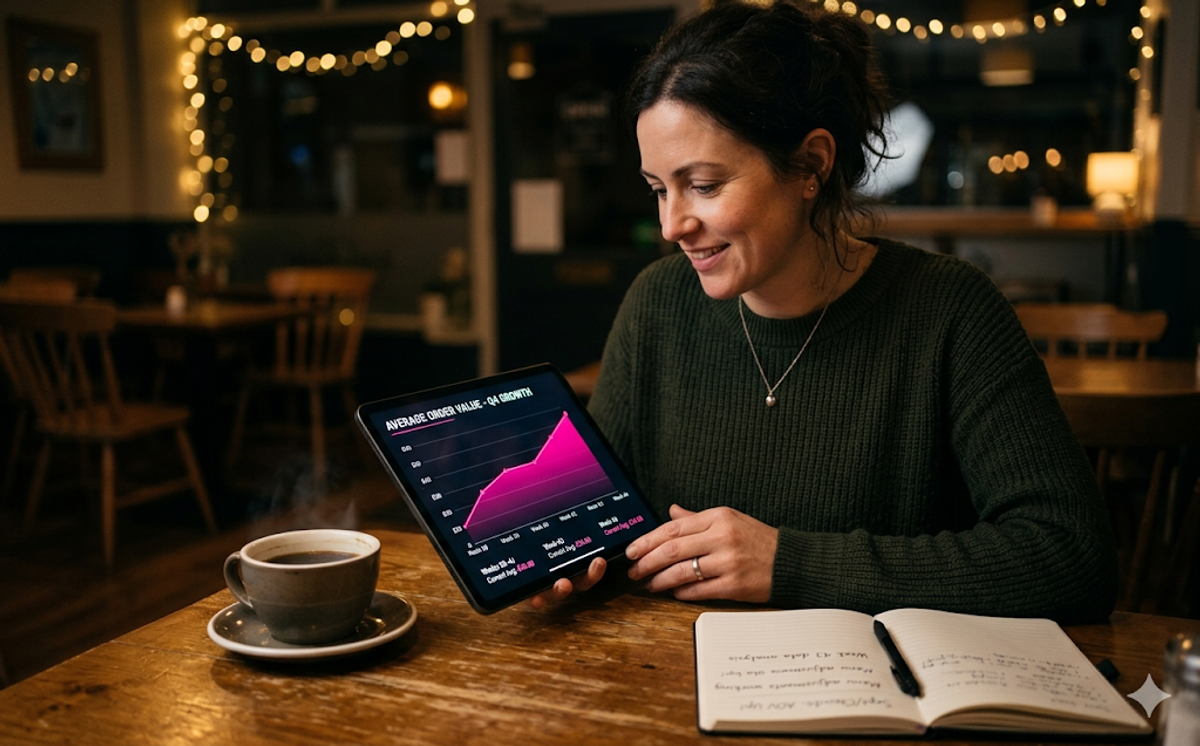
This is where most owners shrug and say, “my paper menu is fine.” The data says otherwise.
Restaurants using Toast’s online ordering see average check sizes 23 percent larger than in-store orders. Toast’s internal data on mobile order and pay shows a 9 percent higher check size compared to standard dine-in, purely because the digital interface lets guests self-upsell through item descriptions, modifiers, and add-on prompts.
On the Indian side, Spice Advisors reports that brands using add-on and pairing prompts on Swiggy and Zomato see an 8 to 12 percent AOV lift. Not because the food got better. Because the ordering experience got smarter.
A good digital menu does three things a paper menu physically cannot. It shows a photo of what the dish looks like on a plate, in your actual light, on your actual table. It suggests what goes well with what, at the exact moment of ordering, not after. And it never forgets to ask.
Do small investments in menu tech pay off long term?
Let’s be straight about the money. A smart digital menu with pairing and add-on logic costs less than what most restaurants spend on a single round of menu reprints per year.
Now run the math the other way. If the new menu adds even 40 rupees per cover, and you serve 60 covers a day, that is 2,400 rupees a day. Over a year, that is close to 8.8 lakh, on the same seats, same staff, same kitchen. The investment is not the cost. The real cost is the quarter of the year you waited before trying it.
Smart restaurant systems have a compounding property that paper menus never will. They learn. They tell you which pairings people accepted and which ones they ignored. They tell you the four combos your regulars actually eat together. That data improves the menu, which improves the next month, which improves the month after.
Paper menus cost you every month they stay the same. Smart menus save you every month they get smarter.
A redesigned paper menu is not enough anymore
Every few years someone hires a designer, redoes the menu in a new font with nicer photos, and calls it a strategy. It is not a strategy. It is a refresh.
A paper menu has a hard ceiling on what it can do. It cannot recommend. It cannot adapt to the time of day. It cannot highlight your new launch for three weeks and then quietly retire it. It cannot tell you which of its items are being read and which are being skipped. It cannot ask “would you like to add a drink?” at the right moment because it has no moments, only pages.
Redesigning a paper menu and expecting higher AOV is like changing the font on your resume and expecting a bigger salary. It looks better. It does not change the outcome.
What a smart menu actually feels like on a Saturday night
Picture a Saturday night at your place. Table of four. They scan the code on the stand. The phone lights up with your menu, photos, pairings, a small “goes well with” line under every main.
One of them taps the biryani. A line appears under it: “pairs with bhuna gosht, served as a side portion.” Another adds a mango lassi after seeing it recommended under a thali. The fourth clicks on a dessert photo and quietly adds it to the order.
Nobody was pushed. Nobody felt sold to. Your server walked past twice and never had to pitch anything. The bill, when it arrives, is 22 percent heavier than the same table would have been three months ago. The kitchen did not break a sweat.
This is what Naira Tap is built to do. Not replace your menu. Make it actually work.
Every scan opens a menu that knows what pairs with what, what combos your regulars eat together, which dishes deserve the top of the screen tonight. You place a small NFC stand on the table, the guest taps their phone, and the menu does the suggestive selling that a rushed server on a Saturday night cannot.
Where to start this month
Pick one thing. Just one. Rewrite the description of your three highest-margin dishes this week. Move them into the visual prime position on your menu. Then, if you are ready to stop relying on a printer, try a digital menuhigh-margin that actually recommends.
Your food is already good. Your customers are already walking in. The only thing left is to stop losing the order value that was always sitting on the table, waiting for someone to ask.