

You are driving to a dental clinic in Aundh. Google Maps says take the next left. You miss it by two seconds. The road has no U-turn for the next kilometre. Backtracking means fifteen more minutes in evening traffic.
You pull over. You open Google. You type "dentist near me." Three clinics show up in the map pack. All three have 4.7 stars or higher. The clinic you were originally going to has 3.9 stars and eleven reviews. You tap the second one on the list. You will never go back to look for the first.
That clinic did not lose you because of its location. It lost you because of its Google reviews. And this happens every day, in every neighbourhood, for every kind of local business. Cafes, salons, opticians, boutiques, gyms, dental clinics. The corner plot used to be the win. Now it is one tap on a phone away from irrelevant.
So the honest question every Indian business owner is asking: can Google reviews actually get you more customers, or is this another SEO story that never pays back? Here is what the numbers say.
Can a 4.7 rating really bring more customers than a good location?
Yes, and by a wider margin than most owners want to hear.
The map pack, that three-result box at the top of every local search, is where 44% of Google clicks go, according to BrightLocal's 2024 Local Consumer Review Survey. Of those clicks, the top three results take 126% more traffic than positions four through ten. Which means if you are not in that top three, you are competing for scraps.
And what decides who lands in that top three? Rating, review count, review recency. Not location alone. Not signboard size. Not how long you have been in business.
87% of consumers read Google reviews before choosing a local business. Only 6% will consider a business rated below four stars. If your rating is below 4.0, roughly 94 out of every 100 people who found you on Google decided not to visit before you ever knew they existed.
The corner location does not save you. The rating does.
For a fuller breakdown of the ranking, response, and profile signals working underneath this, see our post on the numbers behind your online presence.
How do Google reviews actually change your local ranking?
Google publishes its own local ranking rules. There are three factors: relevance, distance, and prominence. Reviews sit inside prominence.
Prominence measures how well-known a business is, both offline and online. Google's own help documentation states it plainly: "Google review count and score are factored into local search ranking. More reviews and positive ratings can improve your business's local ranking."
The Whitespark Local Search Ranking Factors study, run every year since 2015, has placed review signals inside the top five ranking factors for the map pack every single year since 2020.
So how do Google reviews affect local ranking? Three ways. Volume of reviews tells Google you are a real, active business. Star rating tells Google customers actually chose you. Review recency tells Google you are still open and still serving people. All three go into one score that decides who shows up first when someone in your neighbourhood searches. This is why any credible plan for local SEO for businesses treats reviews as a compounding asset, not a one-time task.
Reviews are not a nice-to-have. They are a ranking factor Google publishes on its own help pages.
You can see the full mechanics of how this connects to organic local search in our breakdown of how organic search sends walk-ins to your door.
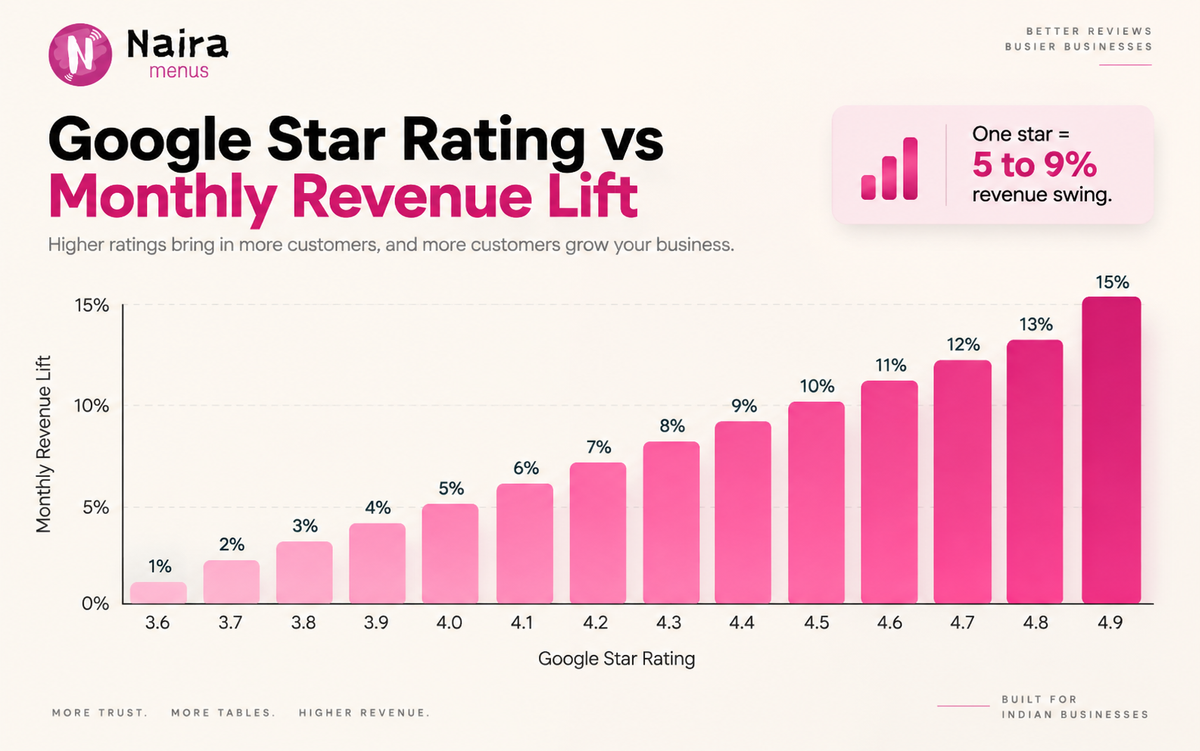
How much does one star on Google change your monthly revenue?
Between 5% and 9% of it. Every star. Both directions.
That number comes from the Harvard Business School study by Professor Michael Luca, which measured Yelp ratings against actual restaurant revenue. The same effect has been replicated across Google reviews by ReviewTrackers and others. It holds across verticals: restaurants, dental clinics, salons, gyms, service businesses.
Do the math on your own business.
Take a Pune dental clinic doing Rs 6,00,000 a month in revenue. Moving from a 3.8 to a 4.5 rating, over ninety days, is worth an extra Rs 30,000 to Rs 54,000 a month. That is Rs 3,60,000 to Rs 6,48,000 a year. From changing one number on a screen.
Now flip it. A cafe drops from a 4.6 to a 4.1 rating because six angry reviews landed unanswered in a bad month. Same math, in reverse. Rs 30,000 a month, gone. Every month, until the rating recovers.
Your Google star rating is the most expensive number your business is not measuring.
For the tactical playbook on lifting your rating, we have covered how to increase your Google review rating without breaking Google's rules.
Why do your happiest customers rarely leave a review?
Because you did not ask.
Only 5 to 10% of customers leave reviews without being prompted. The 5 to 10% who do skew unhappy. According to BrightLocal, unhappy customers are 21% more likely to post a review than happy ones. They have the motivation. Happy customers have the memory of a nice evening. Unhappy ones have a grievance to file.
Which means your Google rating, left to run on its own, drifts downward. Not because your service is bad. Because your feedback loop is broken.
The clinic with an actual 4.7-quality experience but a 3.9 Google rating is not delivering worse than the competition. It is asking worse.
Your Google rating is not what your service is. It is what your unprompted customers wrote about it.
Owners who are still skeptical of all this will find the numbers unpacked further in our post on the evidence that changes owners' minds.
What happens if your business has zero Google reviews?
You do not exist in the customer's mind.
68% of consumers will not consider a business with fewer than ten reviews, according to BrightLocal 2024. The threshold to be trusted at all is around 25 reviews with a rating above 4.2. Below that, you are invisible in three ways at once.
One, the map pack filters you out. Google will not surface you for a "near me" search when the competition has fifty reviews and you have two.
Two, AI recommendations skip you. When someone asks ChatGPT or Perplexity for "the best dentist in Aundh," the model pulls from businesses with visible review activity. No reviews, no mention.
Three, voice assistants ignore you. Google Assistant and Alexa read from Google Business Profile data. If your profile is thin, the voice search reads out someone else's name.
A business with zero reviews is not a bad business. It is a business the algorithm does not know exists. What happens if your business has zero Google reviews is that customers who were ready to visit choose someone else, and you never find out.
A local business with zero Google reviews is not just unrated. It is unlisted in the customer's mind.
How do customers actually find local businesses in 2026?
They search first. They visit second.
Google's own mobile data shows that 76% of "near me" searches result in a visit within 24 hours. That is not a soft intent metric. That is a customer walking in, cash in pocket, wallet open.
The channels have widened, but the ranking logic has stayed the same. Discovery in 2026 happens across four surfaces:
- Google Search and Maps - still the biggest, still where reviews decide the winner
- AI search - 22% of Indian consumers now use ChatGPT or Perplexity for local recommendations, and 83% of local businesses are invisible in these results because their review footprint is too thin.
- Voice assistants - pulling straight from Google Business Profile
- Social discovery - Instagram and WhatsApp, where reviews still act as the trust confirmation before the visit
Every one of these paths ends on a review page. A stranger's opinion, one tap away from being your next customer or your competitor's. This is where good local SEO for businesses lives now. Not on the website. On the profile. Every serious conversation about local SEO for businesses in India starts here, at the Google review count.
Every local search ends on a review page. Yours or your competitor's.
Does replying to Google reviews really help you rank?
Yes, and it changes two things at once.
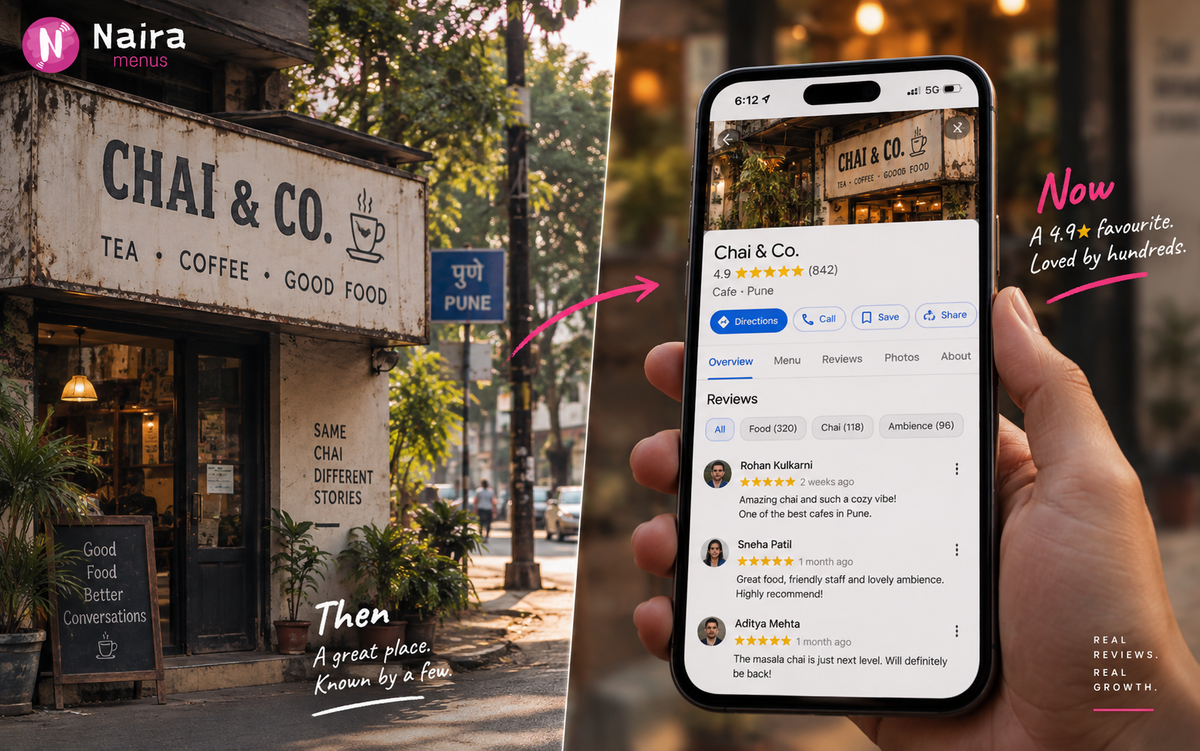
The first is the algorithm. Google treats owner responses as a signal of an active, engaged business. Profiles that reply consistently show up higher in local pack results than profiles that do not, controlling for review volume. BrightLocal reports that 89% of customers read owner responses before choosing where to spend.
The second is the customer. The reply is not written for the reviewer. The reviewer already made up their mind. The reply is written for the next 500 people who read the thread. When a bad review is met with a calm, specific, professional response, the reader thinks, “This owner cares. When it is met with silence or defensiveness, the reader thinks, "This owner does not.
Businesses that reply to reviews earn 35% more revenue than those that do not, according to Womply's small business research.
The reply is not for the reviewer. It is for the next 500 people who read the thread.
Why Google reviews now beat your signboard, your ads, and word of mouth
Because every other channel has a ceiling. Google reviews compound.
Google reviews vs word of mouth is not a fair fight. Word of mouth moves at the speed of a friend telling a friend. Google reviews move at the speed of every stranger deciding at the same moment, twenty-four hours a day, from anywhere in the country.
Signboards worked when everyone drove past your street. Ads work when your card is not maxed out. Word of mouth works when your regulars are talking. Google reviews work when you are asleep.
Google reviews are the only asset your local business owns that works while you sleep.
How a review-first system brings you regular walk-ins (with Naira Growth)
Getting the rating up is not luck. It is a system with four moving parts.
Capture. Put a review request in front of every customer at the moment they are happiest. For a restaurant that is right after the bill is paid. For a salon that is right after the finished look in the mirror. For a dental clinic that is right after the follow-up call. A Naira Tap NFC tag on the counter or a bill folder opens Google's review form with one phone tap. No app to download. No account to log into. Just tap and type.
Cadence. WhatsApp review requests, sent by the owner or automated through Naira Growth, hit open rates above 90% in Indian markets. That is 4 to 6 times what email requests deliver. The right cadence is one message, timed within 24 hours of the visit, with a direct review link.
Response. Reply to every review within 48 hours. Positive ones get a short, warm, specific thanks that names what they liked. Negative ones get a calm, professional acknowledgement that never argues, always offers to speak offline, and never sounds like a template. Both types of reply push your ranking up.
Audit. Look at the profile every week. What did the star rating do? Which reviews came in? What did competitors add? Where did the map pack rankings shift? This is where good SEO services for businesses stop feeling like a black box and start feeling like an operating system. Most SEO services for businesses in India still bill for reports nobody reads. The audit that matters is the one that tells you what changed on your profile this week and what to do about it on Monday.
Naira Growth handles all four parts for dental clinics, salons, cafes, and restaurants across Pune. The NFC hardware, the WhatsApp cadence, the response drafts, the weekly audit. One retainer. One dashboard. One number that goes up.
You do not need more reviews. You need a system that keeps producing them.
Six months later, that same driver has moved neighbourhoods. New dental need. This time she does not even leave the house first. She opens Google. She sees a 4.9-star clinic and a 3.8 one. She books the 4.9.
That clinic's owner has never met her. He may not know she exists. But his reviews already sold her before he opened his door.
Your next customer is choosing you right now. On a screen. Two kilometers away. Based entirely on what your last customer wrote.
If your Google profile has not been touched in months, that is a system problem, not a service problem. Naira Growth runs the capture, response, and audit for you. See where your storefront stands with a free Growth Audit.