

Ginger is up 83 percent. Garlic is up 35 percent. Onion is up 22 percent. Your menu card has not moved since the day it came back from the printer.
That gap is where restaurant profit goes to die. Not in bad food, not in slow service, and not in the rent. It dies in the twelve weeks between the day your supplier raised his rate and the day you finally got around to reprinting.
Restaurant food cost is not a fixed number you set once and forget. It moves every week, in both directions, and it moves whether or not you are watching. The restaurants that survive a price cycle are not the ones with the cheapest suppliers. They are the ones who can see the cost move and respond the same week.
This is the complete guide to what to actually do when food prices rise. How to fix your stock before you touch a single price, how to reprice without frightening your regulars, and why the printed menu on your table is quietly the most expensive object in your restaurant. Everything here is written for Indian restaurants and cafes dealing with rising food costs on a real margin, not a textbook one.
Why does food inflation hurt a restaurant more than it hurts a household?
Food inflation hurts restaurants harder than households because a restaurant buys the same ingredient hundreds of times a month at wholesale volume, and every rupee of that increase lands directly on a net margin that was already only 8 to 12 percent to begin with.
The numbers from 2026 make the point. India's retail inflation sat at 4.45 percent in July 2026, while food inflation ran ahead of it at 5.52 percent, according to CPI data for July 2026. Rural food inflation was 5.79 percent and urban 5.05 percent. But the headline number hides the part that actually hits your kitchen.
Underneath that average, individual items went in wildly different directions in the same month. Ginger rose 83.62 percent year on year. Garlic rose 35.36 percent. Onion rose 22.54 percent. Meanwhile potato fell 16.56 percent and tomato fell 4.59 percent.
Read that again, because it is the whole lesson. There is no such thing as "food got expensive". Some of your ingredients got expensive and some got cheaper, and if you are treating your menu as one block, you are repricing the wrong dishes.
Here is what a 6 percent ingredient increase does to a restaurant running a 32 percent food cost baseline: it pushes food cost to roughly 34 or 35 percent without a single other thing changing. On a net margin of 8 to 12 percent, you have just handed away a quarter to a third of your profit while doing everything else right.
And it compounds in three directions at once:
- Direct cost: Every plate that leaves the pass costs more than it did last month.
- Over-portioning: The extra 15 grams your cook has always added is now 15 grams of a more expensive ingredient.
- Wastage inflation: The same physical amount of spoilage now represents more money in the bin.
Most owners only feel the first one. The second and third are where the real leak is, and they are also the two you can fix this week without touching your menu prices at all.
What is a good food cost percentage for an Indian restaurant in 2026?
A good food cost percentage in India is 28 to 30 percent for quick service, 30 to 32 percent for casual dining, 32 to 35 percent for fine dining, 22 to 26 percent for a cafe, 18 to 22 percent for bar food, and 28 to 32 percent for a cloud kitchen.
Those are the benchmarks. The problem is that almost nobody measures restaurant food cost against them honestly.
Operators routinely undercount recipe cost by 15 to 30 percent, because the calculation quietly leaves things out. The garnish. The spice mix. The oil the thing was fried in. The gas. The chutney that goes out free with every order. None of these feel like cost when you are pricing a dish. All of them are cost when you count the month.
Then there is yield, which is the biggest silent gap of all. You do not buy what you serve.
- Bone-in chicken loses roughly 25 percent between the crate and the plate.
- Whole fish loses 40 to 55 percent depending on the cut.
- Leafy vegetables lose weight to trimming, and more to a second day in storage.
- Paneer and dairy lose to both trim and shrink.
If you priced your chicken dish on the raw purchase weight, your real food cost on that item is already a third higher than the number in your spreadsheet. Before inflation. Add a supplier increase on top and the dish is running at a loss while still selling well, which is the worst combination there is, because volume is now actively harming you.
The rule to work to: your food cost percentage is only useful if it is calculated per item, not across the whole menu. A blended 31 percent can easily be five dishes at 22 percent subsidising four dishes at 48 percent. You do not need to raise all your prices. You need to find those four.
How do you cut food cost without raising a single menu price?
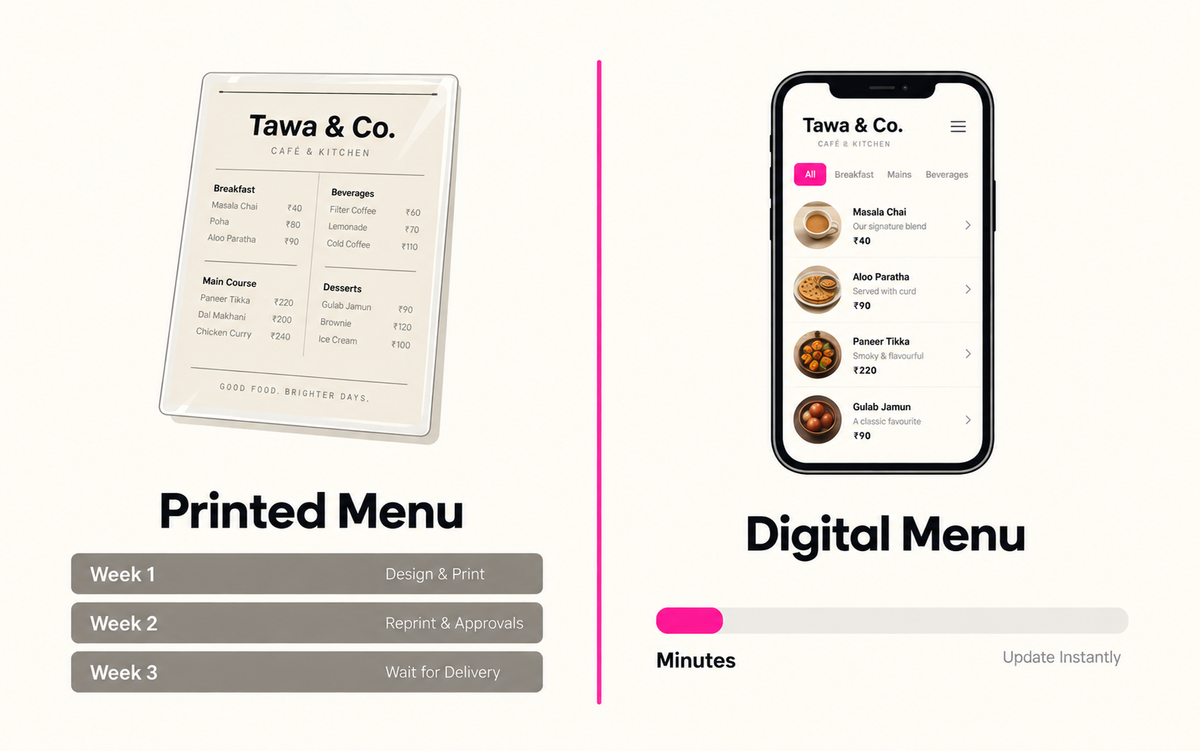
You cut food cost without repricing by fixing three things in your storeroom first: par levels so you stop over-ordering, FIFO rotation so you stop throwing out expiry, and a daily wastage log in rupees so you can finally see what the leak actually costs.
Do this before you touch pricing. Restaurant inventory management is unglamorous work, and it is also where the fastest money is. Every rupee you recover here is a rupee you do not have to ask your customer for, and your customer will never notice you did it.
Set par levels and stop guessing your order
A par level is the minimum quantity of an ingredient you keep on hand to get through to the next delivery, with a small buffer. In inventory management terms it is your reorder floor. It is the single most useful number in a restaurant storeroom, and most kitchens in India run without one.
Without par levels, ordering is a mood. The cook says "paneer khatam ho raha hai" and someone orders twenty kilos because the rate looked good. Nine of those kilos turn into wastage or into a paneer special that nobody wanted.
- Work it out like this: Take four weeks of usage for each key ingredient and find the weekly average.
- Divide by the number of deliveries per week to get usage per delivery cycle.
- Add a buffer of 20 to 30 percent for weekend spikes and delivery delays.
- That is your par. Order up to par, never past it, unless you have a booking that justifies it.
Par levels work best on the twenty or so ingredients that make up the bulk of your spend. You do not need a par level for cinnamon sticks. You absolutely need one for chicken, paneer, oil, onion and whatever your top-selling dish is built on.
Run FIFO properly, not theoretically
FIFO means first in, first out: the stock that arrived first gets used first. Every restaurant owner in India knows the term. Very few kitchens actually run it, because it requires one boring habit that nobody enjoys.
- Date-label every container on the day it arrives, not the day you remember.
- New stock goes behind old stock, always. Physically behind. This is the whole system.
- Front-facing shelves get checked at the start of every shift, not at the end of the week.
- Prepped items get their own labels with prep date, because prepped stock spoils faster than raw.
Restaurants waste 4 to 10 percent of the food they buy before it ever reaches a customer, and 30 to 40 percent of what they do serve is never eaten. FIFO does not fix the second number. It substantially fixes the first, and the first is the one you paid for.
Log wastage in rupees daily, where staff can see it
A wastage log that records "2 kg tomato" changes nothing. A wastage log that records "2 kg tomato, Rs 180" changes behaviour within a week.
Put a single sheet on the kitchen wall. Every item that gets binned goes on it with a rupee value next to it. At the end of the week, total it and put the total on the same sheet in a bigger number. The staff who create the wastage are the only people who can prevent it, and they cannot prevent what they have never been shown.
Most kitchens that start doing this find their first month's total is between 3 and 6 percent of their food spend. That is not a small leak. On a restaurant doing Rs 12 lakh a month with a 32 percent food cost, 5 percent wastage is roughly Rs 19,000 a month walking into a bin.
Standardise portions before you standardise prices
Every recipe should have a written portion spec, and the spec should be on the wall where the dish is made. Not in a file. On the wall.
When food costs rise, over-portioning is the fastest-growing cost in your kitchen and the one nobody is tracking. A cook who has always been generous with the paneer was costing you Rs 4 a plate last year. At today's rate he is costing you Rs 7, on the same generous instinct, and he has no idea anything changed.
This is exactly the kind of leak that shows up in your sales data long before it shows up in your bank balance. If you want to see how to read those numbers properly, our breakdown of what your POS system already knows about where your money is going covers the item-level reporting that makes this visible.
Rebuild your supplier list every quarter, not every crisis
- Get quotes from at least three suppliers for your top ten ingredients, once a quarter, whether or not you plan to switch.
- Ask for a rate card with a validity period rather than a daily rate. Even a two-week lock helps you plan.
- Buy volatile items short and stable items long. Onion and ginger short, oil and grains long.
- Where a substitute genuinely works, keep it approved and costed in advance so you can switch inside a day when a rate spikes.
The point of quarterly quotes is not to squeeze your supplier. It is to know the market rate so you can tell the difference between real inflation and a rate your supplier decided to try.
Should you raise menu prices when food costs rise?
Yes, but not across the board and not all at once. Raise prices on the specific items whose cost actually moved, in small staggered increments, on dishes where customers are least price-sensitive, and leave your signature value items alone.
The blanket 10 percent increase is the most common mistake in Indian restaurants and the most damaging of all menu pricing strategies. It punishes your regulars on the dish they came for, it raises prices on items whose cost did not move at all, and it announces itself loudly enough that people notice.
The research on how diners actually react is worth knowing, because it contradicts what most owners assume. In a November 2025 eye-tracking study of 358 participants run by RMS with Cornell professor Sherri Kimes, researchers found that explaining a price increase on the menu makes almost no difference. Customers looked at the item and the price. They did not read the explanatory note. Perceived value drove loyalty, not the justification.
So the apologetic "due to rising costs" line on your menu is doing nothing. What works instead:
- Reprice by sensitivity, not by category. Beverages, desserts and add-ons tolerate increases far better than your headline main course. A Rs 10 rise on a cold coffee is invisible. A Rs 40 rise on your signature biryani is a conversation.
- Move in small steps, more often. Four increases of Rs 10 across a year land softer than one increase of Rs 40, because each one falls under the threshold at which a regular consciously registers a change.
- Never cross a psychological price point casually. Rs 280 to Rs 299 is fine. Rs 299 to Rs 310 costs you more orders than the Rs 11 is worth. Price to Rs 299, Rs 349, Rs 449.
- Protect one or two visible value anchors. Keep your most-ordered, most-talked-about item stable for as long as you possibly can. It is what people quote when they describe your prices to a friend.
- Rebalance instead of raising, where you can. Reduce a garnish, change a side, restructure a combo, or shift the layout so a higher-margin item sits where the eye lands first. Not every margin fix is a price fix.
That last one is menu engineering, and it is the most underused of all menu pricing strategies. It is often worth more than the price rise itself. Our guide to the menu design tricks that increase average order value covers the layout and pricing psychology in detail, and it applies directly here: the same page that raises AOV also decides which of your repriced items people actually see.
Timing matters too. The most reliable repricing rhythm is a full recipe cost rebuild twice a year on your top revenue dishes, phased over two to four weeks rather than switched overnight, with light corrections in between whenever a specific ingredient moves sharply.
Which brings us to the actual problem. Everything above assumes you can change a price when you decide to. Most restaurants cannot.
Why is a printed menu the most expensive object in your restaurant?
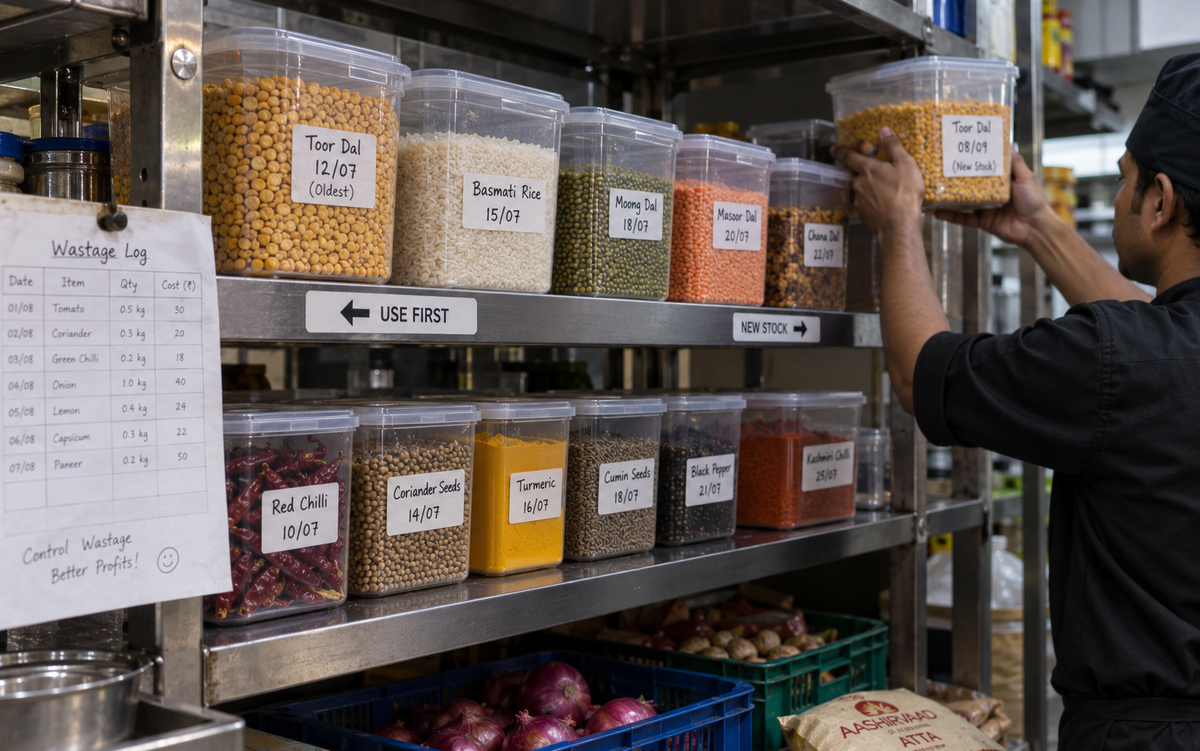
A printed menu is expensive not because of what it costs to print, but because of what it costs you to wait. Every week between a cost increase and your reprint is a week of selling at last season's prices, and that delay costs far more than the printing ever did.
Start with the visible cost. Menu card design in India runs from around Rs 600 per page and printing from around Rs 100 per page, before lamination, before binding, before the cost of the third round of proofs because someone spotted a spelling mistake. For a 40-cover restaurant, a full reprint including design, print and lamination typically lands between Rs 8,000 and Rs 25,000 per round. Do it four times a year and you have spent up to a lakh on paper.
But the printing bill is the small number. Here is the big one.
A price change on a printed menu is not an edit. It is a project. Approve the change, brief the designer, wait for the proof, correct the proof, wait for the print run, wait for lamination, collect them, and distribute them across the floor. Two to four weeks is normal. Longer if you are busy, which you always are.
Now multiply. If your food cost went up 6 percent and you took three weeks to reflect it, you sold roughly three weeks of covers at the old price with the new cost. On a restaurant doing Rs 3 lakh a week, that delay alone is worth more than the entire reprint bill.
And because the reprint is expensive and slow, owners do the rational thing: they wait. They batch changes. They tell themselves they will do it "when we redesign the menu anyway". So the item that should have gone up in June goes up in October, and for four months a dish that should be earning you 32 percent is earning you 19.
- The printing cost is the number you see.
- The lag cost is the number that actually takes your margin.
- The lag cost is bigger, every single time.
We ran the full arithmetic on this in our breakdown of what paper menus really cost an Indian restaurant, including the reprint frequency most owners underestimate. If you have never costed your menu as a line item, start there.
There is a second cost that is easy to miss. A printed menu cannot carry a strikethrough, a seasonal item, a temporary substitution or a sold-out marker. So when your supplier fails on Thursday, your staff spend Friday and Saturday apologising for items that are on the menu but not in the kitchen. That is a service cost, a review cost, and a customer-trust cost, all created by a piece of laminated card.
How does a digital menu protect your margin when food prices move?
A digital menu protects your margin by collapsing the gap between a cost increase and a price change from weeks to minutes. You edit the item on your phone, and every customer who scans or taps from that second onward sees the new price, at zero incremental cost.
This is the core argument for digital menus, and it has nothing to do with looking modern. It is a speed argument.
When your menu lives on a screen instead of a card, repricing stops being a project and becomes a Tuesday morning task. That changes behaviour, and the behaviour change is where the money is:
- You reprice when costs move, not when the printer is free. The three-week lag disappears. So does the four-month lag on the item you kept postponing.
- You reprice small and often. The staggered Rs 10 increases that customers barely register are only practical when a change is free. On paper, small changes are not worth a reprint, so owners save them up into one big painful one.
- You reprice by item, not by menu. Ginger went up 83 percent and potato fell 16 percent. A digital menu lets you respond to that precisely. A printed menu forces you to respond to it bluntly.
- You run seasonal and market-rate items honestly. A monsoon special that exists for six weeks is impossible to justify on a printed card and trivial on a digital one.
- You mark items unavailable in real time. Supplier failed on Thursday? Toggle it off. No apologies, no disappointed table, no one-star review about a dish you could not serve.
- You push high-margin items to the top. When one dish's cost spikes, you can demote it and promote its healthier neighbour the same day, which often protects margin better than a price rise would.
The customer side has caught up to this too. Around 58 percent of diners are happy to access a menu by scanning, 64 percent will order through an app, and 11 percent say they would avoid a restaurant that has no digital menu at all. Digital orders already make up roughly a third of all restaurant orders. The screen is not the future of your menu. It is the present of it.
Digital menus also carry things paper never could: photographs, dietary tags, descriptions, and a highlight on your high-margin items. Those are conversion tools, not decorations. Our post on why changing your restaurant menu matters covers what happens to order patterns when the menu becomes something you can actually update.
QR code or NFC? What kind of digital menu should a restaurant actually use?
Both solve the update problem equally well. The difference is in the customer experience: a QR code asks the customer to open a camera, aim, and tap a notification, while an NFC tag asks them to touch their phone to the table and nothing else.
For the margin argument in this blog, either works. Any digital menu beats a printed one on repricing speed. But the two are not equivalent at the table.
- QR codes are cheap, universal and familiar, and every phone supports them. They are also visually cluttered, they fail in low light, and after five years of pandemic-era stickers, customers have stopped finding them interesting.
- NFC tags need no camera, no aiming, and no app. The customer taps the tag and the menu opens. It reads as premium rather than as a cost-saving measure, which matters when you are also raising prices.
We compared them properly in our NFC menu versus QR code comparison, and looked at why Indian restaurants are moving across in this piece on the quiet switch to NFC menus in India.
One practical note on timing. If you are planning a price increase, that is exactly the moment to upgrade the menu experience, not six months later. A better-looking, faster, photographed menu changes the value perception on the same visit where the price changed. And value perception, according to that Cornell-linked study, is the thing that actually protects loyalty. Not the explanation.
What does Naira Tap do when your food costs move?
Naira Tap is an NFC and QR digital menu built for Indian restaurants and cafes, where a price change takes about fifteen seconds and reaches every table, every takeaway customer and every listing link at once.
Here is the specific workflow this blog has been building towards:
- Your supplier raises the paneer rate on Monday morning. You open the Naira dashboard on your phone, change the price on the four dishes that use it, and save.
- The change is live before lunch service. Every tag on every table now opens a menu with the correct price. No printer, no proof, no delay, no cost.
- The dish that spiked gets demoted. Reorder the layout so your better-margin item sits where the eye lands first. Same two minutes.
- The item you cannot source goes dark. Toggle it off instead of letting a table order something your kitchen cannot make.
- Photos and descriptions do the value work. Every item carries an image slot, a description, dietary tags, and a highlight option, so a repriced dish still looks worth what you are now asking.
- Seasonal pricing becomes normal. Monsoon menu in June, winter menu in November, market-rate seafood on a Friday. All of it possible because none of it costs anything to change.
The pitch is not that a digital menu is modern. It is that a printed menu makes you slow, and in a year where ginger moves 83 percent and potato moves the other way, slow is the expensive part.
See how Naira Tap handles a price change. Try it free at nairamenus.in/naira-tap and change a price on a live menu in under a minute.
And if the wider problem is that people are not walking in at all, rather than that your margin is thin, that is a different fix. Our posts on the diners you are losing to Google and six ways to increase restaurant sales cover the demand side. Margin protection only matters if the covers are coming in.
A 30-day plan for when prices rise
If you do nothing else from this blog, do this in order. Fixing stock before pricing, and pricing before printing, is the sequence that costs your customer the least.
- Week 1, measure. Pull item-level sales and item-level restaurant food cost data from your POS. Rebuild the recipe cost on your top ten dishes by revenue, this time including garnish, oil, spice and yield loss. You will find at least two dishes running far worse than you thought.
- Week 2, fix the storeroom. This is the inventory management week. Set par levels on your top twenty ingredients. Start date-labelling and enforcing FIFO. Put the rupee wastage sheet on the wall. Write portion specs for your five highest-volume dishes and stick them where they are cooked.
- Week 3, reprice surgically. Raise prices only on the items whose cost actually moved, in small steps, favouring beverages, desserts and add-ons. Protect your value anchor. Respect the psychological price points.
- Week 4, remove the delay permanently. Move the menu off paper so that next time, weeks one to three are all you need and week four never has to happen again.
Rising food costs are not an event you survive once. They are a permanent condition of running a restaurant in India, and they will move again. The question is not whether you can predict them, because you cannot. The question is how many days it takes you to respond, and that number is entirely within your control.
Want one practical idea like this every week? We send restaurant and cafe owners across India one short, useful thing they can act on the same day.